Please indulge me quoting myself from previous chapter: “The Portuguese are among the few, if not the only Europeans that use a different original Chinese expression “chá”, instead of tea and its derivatives. Cockney English uses cha or rather char too,” as I was surprisingly confronted with by my mother’s next door neighbour in England, when delving there for my one academic year long sabbatical. “The Portuguese probably first came across the drink in the Canton region, and used the local word (ch’a). Later, other Europeans encountered it in the Tonkin region and also adopted the local word (t’e).” (José E. Mendes Ferrão, “A aventura das plantas e os descobrimentos portugueses”, 2005, 3rd edition, p.200)
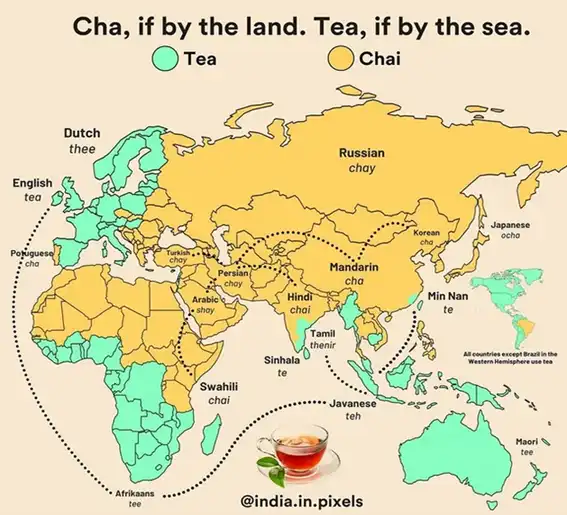
Let’s move a few steps back: “Did you know that most of the world uses the same two words for tea? One variation is the one used in English (tea), French (thé), Spanish (té) and Dutch (thee). The other is a variation of chá (in Mandarin and Cantonese), such as chai in Hindi, shay in Arabic and chay in Russian. There’s an interesting reason for this.
Both words originate in China, which is widely believed to be the ‘home of tea’ and where the plant was first domesticated, and come from the Chinese character: 茶. In Mandarin and Cantonese, it’s pronounced ‘cha’. Countries around the world that use the word ‘cha’ originally imported tea over land, through the Silk Road, from the northern regions of China where they pronounce the word ‘cha’.
However, in the dialect spoken in the southern coastal province of Fujian, the word is pronounced ‘te’. This port is where 17th century Dutch merchants traded tea to bring to Europe, bringing back with them the pronunciation of ‘tea’. There are, of course, exceptions to this. But for the most part, wherever you are in the world, there’s a good chance you’ll know how to ask for a cup of tea with just those two words!” (From “A cup of tea… or cha?”, Food and Agriculture Organization of the United Nations, as accessed October 8, 2025)
“The fact is that in the several dialects or languages of the great China there are variations of the word and according to the region where the European merchants made business, they heard a certain sound for tea which they later adopted in their countries. In Macao, where the Portuguese established and traded from the 16th century on, the version cha was the one they heard and imported…which resulted in our sweet and tender chazinho. 🙂 Of course they imported the word as they imported the product as well as the delicate recipients to serve it, like the porcelain little bowls you can see above.” (From the blog “Artes, livros e velharias”, by Maria Andrade, as accessed Oct.8, 2025)